
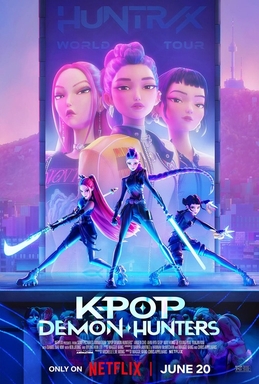
Netflix’s original musical animation K-Pop Demon Hunters has achieved significant global popularity and continues to set new records. By the end of July, the sixth week since its release, cumulative views had surpassed 130 million, thus earning it the title of “Netflix’s most-watched animated film.”[1] Its original soundtrack has also gained notable popularity. Eight songs featured in the film entered the Billboard Hot 100 chart, with the title track, entitled “Golden”, reaching No. 2 on the Hot 100 and No. 1 on the Global 200 chart.[2] On September 19, the 91st day since its release, Netflix concluded its all-time ranking tally, with K-Pop Demon Hunters achieving 325.1 million views—the highest view count among all Netflix titles.[3] Following the success of K-Pop music, Korean films, and Korean dramas, the consecutive triumphs of Korean animation have led those advocating the “K- ” culture movement to once again assert the preeminence of the Korean Wave. Meanwhile, within the Korean Protestant community, which generally shows minimal interest in popular culture phenomena or the Korean Wave, a critical perspective emerged concerning the glorification of shamanistic beliefs as depicted in this work. Concerns have been voiced regarding the success of this animation, as it could potentially globalize shamanism, presenting it as an attractive component of Korean culture.[4] The prevalence of discourse surrounding K-Pop Demon Hunters is indicative of its phenomenal appeal to the world.
Indeed, this work has been of interest to me since the release of the trailer. From the standpoint of an individual involved in academic research that focuses on Christianity and culture, the combination of religion and popular culture, especially with regard to the occult and K-Pop music, appeared to be a novel and intriguing concept. However, I did have concerns about my ability to engage with K-Pop music. It is because K-Pop music proved to be a challenging and somewhat inscrutable cultural phenomenon to me. My concerns were even developed into a suspicion that this animation might be a superficial endeavor to capitalize on the global popularity of K-Pop music. However, following a thorough viewing of K-Pop Demon Hunters, it became evident that the musical components did not constitute a significant hindrance. Indeed, the experience was rather enjoyable. Even an individual who generally experiences difficulty with K-Pop music found the inserted songs, which were performed concurrently with the elaborate scenes, to be appealing. It can be argued that, following Frozen, K-Pop Demon Hunters may be the best musical animation in which the music is of such significance.
Moreover, the notion that K-Pop singers occupy the role of protagonists in this narrative appeared somewhat far-fetched, yet this was readily accepted by the audience due to the strength of the compelling narrative. K-Pop Demon Hunters portrays a confrontation between an evil spirit known as Gwi-Ma, which derives its potency from the consumption of human souls, and hunters who have engaged in combat with Gwi-Ma for successive generations. The team of three female hunters, who initially assumed the role of shamans during the Joseon Dynasty, have adopted different guises throughout history. They have adopted the guise of performers in various eras and now operate in 21st-century South Korea as K-Pop idol singers known as the Huntrix. The objective of Huntrix is to gather the hearts of their fans in order to perform a soul-binding ritual that will destroy Gwi-Ma. In response to this, the Gwi-Ma‘s subordinates constitute a five-member male idol band known as the Saja Boys, with the objective of bewitching people and extracting their souls. Consequently, Huntrix and Saja Boys compete to win over fans. The analogy between idol singers competing for fandom and the battle between good and evil over human hearts, along with the similarities between Korean shamanic culture, which once considered as a comprehensive art form, and K-Pop music at the pinnacle of the popular culture industry, provide a sufficient answer to the question, “Why must the protagonists be K-Pop singers?”
It is possible that the satisfaction derived from the two aspects of the animation that had initially caused concern – the music and the narrative – led me to the conclusion that K-Pop Demon Hunters is a well-directed animation that can be appreciated by a wide audience. The conclusion drawn was that the piece’s global popularity was likely attributable to the excellence of its music and narrative. However, a survey of relevant articles, blogs and social media posts revealed that numerous Koreans cited the influence of the “Korean Wave” as a significant factor in the success of this animation.[5] They assessed that the depiction of “Korean culture,” “Korean landmarks,” and “Korean traditions” was accurate, and that foreign viewers found this appealing. A majority of these articles concluded with statements emphasizing the competitiveness of the “Korean Wave” and the globalization of “K-culture.” It is evident that the incorporation of Korean cultural elements within KPop Demon Hunters has garnered significant interest from an international audience. However, it is challenging to attribute this phenomenon exclusively to “the power of the Korean Wave” demonstrated by “K-animation.”
As is already known, this work was directed by a Korean Canadian director, Maggie Kang, and a significant portion of the production team, including the voice actors, are also Korean Americans. This may be a contributing factor that the depiction of Korean culture in K-Pop Demon Hunters feels awkward to native-born Koreans. The most illustrative example of this phenomenon is the depiction of Korean herbal medicine shops. A parallel may be drawn between the emotional response experienced by native-born Koreans when confronted with images of Korea’s natural beauty as depicted by foreign observers and the discomfort evoked by scenes in K-Pop Demon Hunters. While these scenes endeavor to depict Korean society, they do not fully align with the anticipated cultural characteristics of the region. This phenomenon can be attributed to the reinterpretation of familiar and natural elements of Korean society through the perspective of overseas Koreans, leading to their subsequent reproduction. The cultural elements depicted in K-Pop Demon Hunters were created in a similar manner. The presentation of Korean culture recreated through overseas Koreans’ lens. The question arises as to whether this can genuinely be designated as Korean wave, or K-content. At least, defining it within the existing concept of the Korean wave which stresses “the most Korean is the most global” is not viable.[6]
These hybrid characteristics are not confined to specific scenes or props within the work. A point of contention surrounding K-Pop Demon Hunters was its popularization of Korean shamanistic beliefs. At first glance, this appears to be the case, as the protagonists are exorcists who follow in the footsteps of shamans to defeat evil spirits. However, the demonic entity with which they ultimately engage is an evil for which the reason for existence remains unknown. The concept of evil that has always existed is in contrast to the Korean shamanistic perspective on evil. In the context of Korean shamanistic belief systems, the concept of evil is often attributed to the presence of resentment (or “Han”). It is therefore the role of the shaman to resolve this evil through the process of resolving resentment(“Hae-won”). While there is evidence to suggest the existence of shamanic exorcists in Korean shamanism, these figures remain negligible. Thus, it is argued that this practice originates from older folk beliefs with strong cultic characteristics, or from non-mainstream elements within shamanism itself, rather than being central to Korean shamanism. In contrast, Western religions regard exorcism as the sole method for dealing with evil. The concept of evil is often regarded as an inherent, albeit enigmatic, force that is believed to demand confrontation and eradication. In this sense, the scenes in which Huntrix vanquishes evil spirits with holy weapons are meticulously crafted to align with the Western religious perspective, which is more familiar with the practice of exorcism than with the resolution of resentment.
However, it would be also erroneous to categorize this work as a conventional Western occult piece that merely incorporates Korean aesthetic elements. Western occult works are characterized by a persistent dichotomy between good and evil. In contrast, K-Pop Demon Hunters advances the argument that “tolerance” and “reconciliation” – rather than ‘hatred’ and ‘conflict’ – represent the only viable path to restore a world shattered by the fierce confrontation between good and evil. This encompasses the notion of evil itself. It is evident that the narrative does not portray a definitive confrontation between good and evil, wherein the forces of light emerge triumphant in a battle for supremacy. Instead, it presents a resolution to the ongoing discord between these two entities, achieved through the acknowledgement and comprehension of the existence of evil. This narrative bears a closer resemblance to a modern interpretation of the Korean concept of “Hae-won” than to a Western religious worldview. The synthesis of Western-style evil and Korean-style resolution has resulted in the emergence of novel occultism.
It is evident that K-Pop Demon Hunters employs Korean elements as its subject matter, yet it is a hybrid work that reinterprets and reimagines them from diverse perspectives. Consequently, it appears reluctant to designate it as a triumph of the Korean Wave or to assert its position as the future of the Korean Wave. It may be opportune to consider a re-definition of the Korean Wave itself. The adaptation of Korean culture for a global audience must not be at the expense of its unique characteristics. Instead, it is the process of generating genres that are resonant with them. This strategic realignment has also had a positive impact on us. This phenomenon enables the perception of previously inaccessible aspects of reality, thereby facilitating the pursuit of novel alterations. This realization is not exclusive to the phenomenon of the Korean wave, but is also applicable to the domain of religion. A narrow religious perspective can potentially obscure the full complexity and significance of the world around us. To be specific, a superficial focus on criticizing the shamanistic beliefs depicted in K-Pop Demon Hunters diverts attention from the central message of the work, which borrows the concept of “religion.”[7]
The fact that it resolves the conflict between good and evil through “tolerance” and “reconciliation,” and that such a narrative – strongly imbued with religious characteristics – achieved global success, clearly shows the path religion should take today. It is important to note that this is not an advocacy for the creation of a hybrid religion. Instead, it encourages us to examine the present state of affairs in which religion itself frequently becomes a source of conflict. The true function of religion, it could be argued, is not simply to pay lip service to the “preciousness” of all existence, but to genuinely perceive it as “golden.”
Min Hyoung Lee
Sungkyul University, Anyang, South Korea
[1] Pallabi Bose, “All the Records Set and Broken by Netflix’s KPop Demon Hunters,” Prestige, August 28, 2025, https://www.prestigeonline.com/hk/lifestyle/culture-plus-entertainment/kpop-demon-hunters-records-netflix/
[2] Koe Ewe, “KPop Demon Hunters Goes Golden with Billboard Chart-Topping Hit,” BBC, August 12, 2025, https://www.bbc.com/news/articles/cvg3n5m1ymko
[3] Emily Horgan, “‘KPop Demon Hunters’ Ends Historic Netflix Top 10 Run: How It Became the Streamer’s Biggest Ever Hit,” What’s on Netflix, September 23, 2025, https://www.whats-on-netflix.com/news/kpop-demon-hunters-ends-historic-netflix-top-10-run-how-it-became-the-streamers-biggest-ever-hit/
[4] Wook Joo Park, “What’s the Problem with ‘K-Pop Demon Hunters’ Glorifying Shamanism Through K-Pop?” Christian Today, August 4, 2025, https://www.christiantoday.co.kr/news/369815
[5] A search for “K-pop Demon Hunters” and “Hallyu” will direct the reader to a multitude of articles, blogs, and social media posts on the aforementioned topic. The following link is an illustrative example. https://goodfuturedaily.co.kr/%EC%BC%80%EC%9D%B4%ED%8C%9D-%EB%8D%B0%EB%AA%AC-%ED%97%8C%ED%84%B0%EC%8A%A4-%EC%8B%A0%EB%93%9C%EB%A1%AC-5%EC%B2%9C%EB%85%84%EC%9D%98-k-%EC%BB%AC%EC%B2%98-dna%EB%A1%9C-%EA%B8%80%EB%A1%9C%EB%B2%8C/
[6] Following the recognition of the employment of this expression by the Korean director Bong Joon Ho, it underwent a period of widespread usage among individuals seeking to underscore the strengths of Korean culture. However, it was later revealed that Director Bong had never used this expression, and it has been criticized as an overly nationalistic expression regarding Korean culture.
[7] As indicated in footnote 2, the article cited is not the only source of this criticism; various Christian organizations and churches in Korea have also published articles or statements criticizing the religious message of KPop Demon Hunters as simply “shamanistic.” Concurrent with these events, reports have surfaced of a British missionary school implementing measures that prohibit students from singing the theme songs of KPop Demon Hunters, citing concerns regarding the work’s religiosity. Curtis Lancaster, “School Bans Singing of KPop Demon Hunters Songs,” BBC, November 17, 2025, https://www.bbc.com/news/articles/ceq03r3z2eqo.
Categories: Reviews


Leave a Reply