
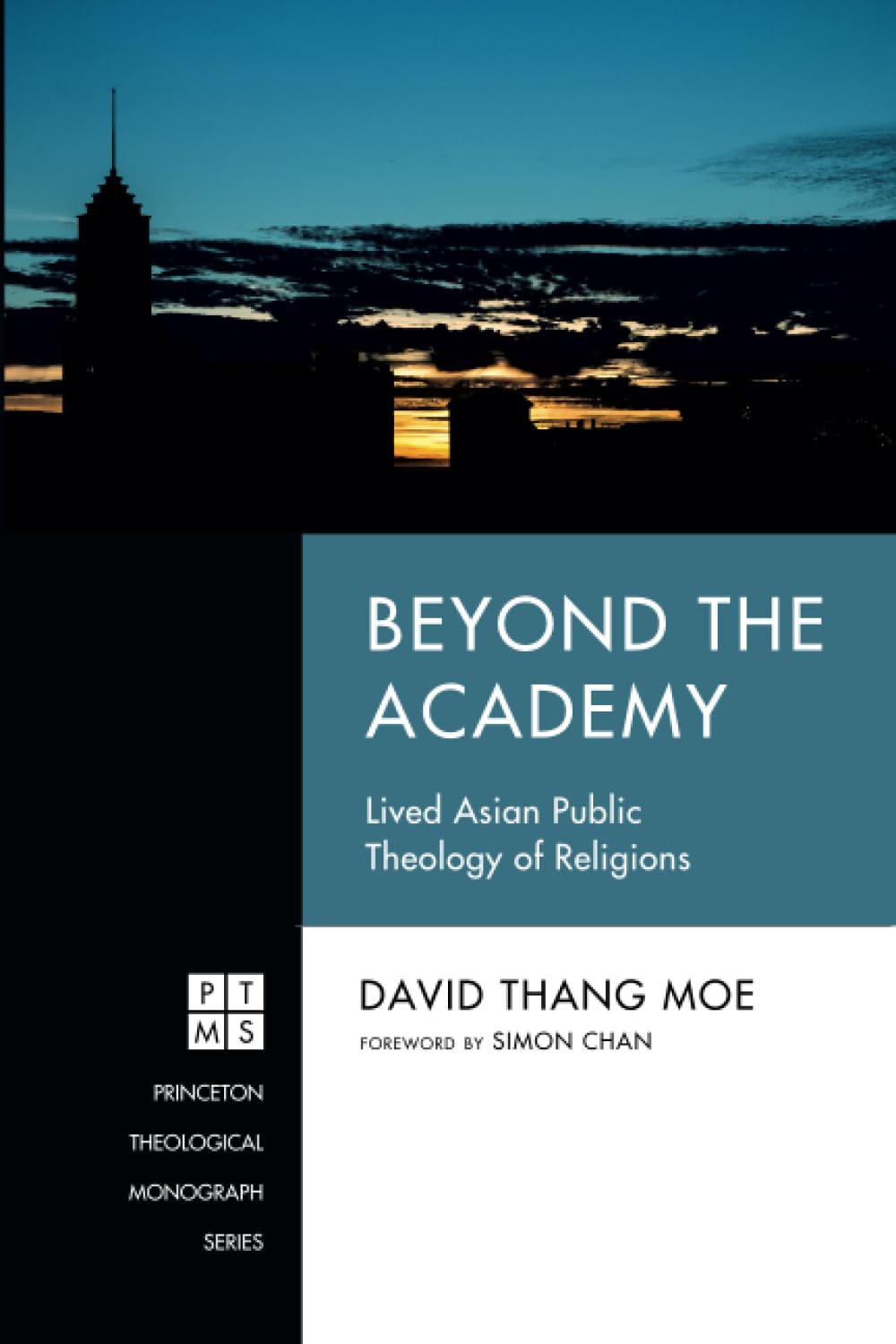
Beyond the Academy: Lived Asian Public Theology of Religions is at once a window into the spiritual lives of Christians across Southeast Asia and a prescriptive mirror for the academy of public theology. In clear terms, it reckons with the deeply political nature of Asian public theology as it stands in contention with its desire to be apolitical, imploring the academy to reconsider its relationship with the lived practice of resistance against nationalism in Southeast Asia as integral to religion. Simultaneously, it provides a new vision for what theology can look like at a grassroots level, as well as foundational methodology for how academics should communicate and document public theology from the ground up.
David Thang Moe, Yale University’s Henry Rice Postdoctoral Associate and Lecturer in Public Theology and Southeast Asian Studies, writes with unique insight as both an academic theologian and as a Christian ethnic minority from Myanmar’s hill rural region in Chin State.
Having seen firsthand state-building in Southeast Asia rupture national identities and minority groups’ capacity for self-determination, Moe evaluates critical realities of ethnic minority and subaltern resistance within the institution of public theology. His imperative for writing Beyond the Academy stems from a dissonance between academic theological discourse and lived ecclesiastical practice. Moe positions himself as both an “insider” and an “outsider” to the subjects in his ethnographic interviews, a positioning that underpins and polishes the tensions between academy and church and faith his research elucidates. Grappling with the politics prescribed by Western colonial and post-colonial powers and the theology prescribed by the Western academy, the religious landscape of Southeast Asia imagines a different voice in the study of God. In this imagination, Moe lays the groundwork for foundational discussions around Asian public theology as a theology of liberation.
Redefining the existing field of public theology as “grassroots theology,” Moe takes the steps to make ethnography intrinsic to the work of lived Asian public theology. He effectively articulates the ideological domination of the academy over the “Christianity of the oppressed,” arguing that the nature of theology and its objectives change and must be changed within the context of Southeast Asia. His observation of the “paradox of Christianity” illustrates a paradigm where Christians in Asia are “double minorities”—by religion and ethnicity—and subject to extreme poverty and political persecution. In Southeast Asia, in particular, many minority Christian communities exist in the region’s hill rural villages, making up much of the peasant class. For Moe, this context is critical to building the foundation for the theology of grassroots Christianity.
Moe’s most radical undertaking in this work is his argument that Asian public theology must be fundamentally and expressly tied to the reality of religious pluralism and the struggle against domination, for the faithfulness of practicing minority communities cannot be conceived in whole without their positionalities as the subjugated. Under this claim, he analyzes primal religion as nourishing to Asian public theology. Moe’s advocacy of praxis in interacting with Asian public theology demands expanding the mediums through which theological discourse is documented. For minority Christians in Southeast Asia, faith is a verbally sustained condition, and the method of “bearing witness” is through the oral tradition. Indeed, the story theology that Moe discusses in conversation with theologian Simon Chan references not only the system of the local ecclesial communion, but also from the people’s direct interpretation of the scripture itself: Jesus was a storyteller. In Moe’s understanding of the glocal dialogue between Asian and non-Asian public theologians, he levels one of his sharpest critiques: that outside theologians, lacking any substantive knowledge of grassroots Asian practice, default to analyzing political powers rather than spiritual ones when constructing Asian public theology. In making this argument, he raises an epistemic and moral justification for adding new methodology to the field, laying the foundation for future literature to more formally recognize such mediums as academic evidence.
In a more critical sense, Moe’s argument for understanding Asian public theology as a resistance-based grassroots theology encounters some shortcomings. In some areas of this book, he thoroughly investigates “relevant” theology in the lives of everyday, ordinary Christians, and his facilitation of their theology is intimately associated with his belief in intra-religious dialogue. But in establishing this premise, the definition of the “public” of theology is lacking. Because this book interacts heavily with theories of resistance and domination, a clearer discourse on the political, religious public, and counterpublic beyond an operational definition of “everyday people” would have been appreciated, especially if Moe’s argument that Asian religious identity cannot be separated from political identity is accepted. Further discourse on who the public includes and what public practice includes, whether it is the visible practice of religious rites or subaltern true belief, would have added another dimension to Moe’s theory of religion and resistance.
In its unique position as literature published in the academy, this book stands staunchly against “importing theology” from the academy and makes itself a vessel for revealing the vibrant and dynamic domestic theology of grassroots Asian Christians. In doing so, Beyond the Academy is particularly triumphant in the ethnographic element of its goals, introducing new methodologies in documenting religious practice and theology in Southeast Asia and breathing new life into theological research. Moe’s own background as one belonging to both worlds, the academy and the village, yet not fully an insider in either, deepens the quality of his ethnographic research. Whether such observations can truly be accepted by the academy remains to be seen.
Ultimately, this book is David Moe’s homage to the small church congregation and the local preacher’s pulpit. It is his recognition of the shared theology that has long been woven and rewoven by grassroots theologians who preach and study from the heart. In this regard, Beyond the Academy does more than what it promises, it reimagines the academy too.
Abigail Hu
Yale University
Categories: (T) Book Review


Leave a Reply