
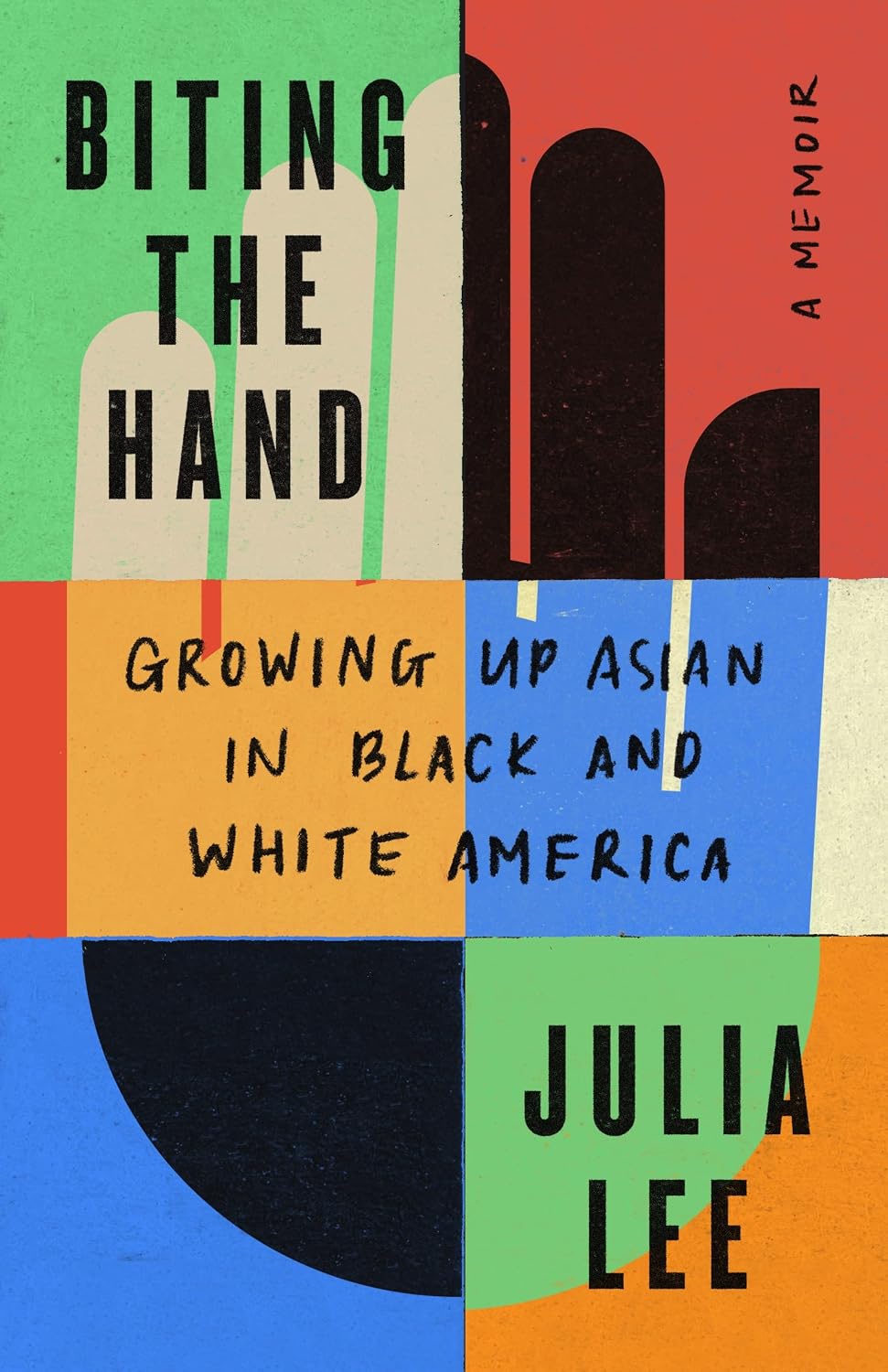
Julia Lee’s Biting the Hand: Growing Up Asian in Black and White America (2023) is an unflinchingly candid personal narrative, yet her voice compels readers to confront the communal and systemic realities we inhabit—and continually reproduce. She fearlessly places herself in a vulnerable position, acknowledging that she, too, as a racial minority from an immigrant family, is shaped by a distorted society that continually reproduces colonial ways of thinking and being, and white supremacist ideology.
While Lee traces her personal journey as a Korean American growing up in an immigrant family, I found my own stories echoed in her narrative as a Korean immigrant. This shared ground she cultivates becomes, in itself, a safe and affirming space where racial minorities can recognize one another and empathize freely with each other, forming solidarity—especially as they struggle to survive within a Eurocentric, colonial social order that demands so much of the racially and culturally marginalized.
At the heart of the book, Lee wrestles with what it means to be herself, inhabiting a liminal space where she does not fully belong. This condition reflects a repeated, harsh experience of negation—being defined as not white, not Black, not one of “us.” Her account of being asked by a white woman how she speaks English so well captures this reality of being rendered a perpetual foreigner in one’s own country.
The candidness shines when she refuses to romanticize immigrant struggle or resilience, especially as she portrays her relationship with her mother, who is, at once, a victim of oppression shaped by white supremacy and one who, often, complies with its expectations—even yearning for the lives of conquistadores. This bold and unflinching reflection resonates deeply with Paulo Freire’s concept of “internalized oppression,”[1] reminding us that under Western colonial order, we can become both oppressed and oppressors—often disturbingly oscillating between the two. Instead of romanticizing her story or rendering it more palatable, Lee exposes the deceiving, masking, and often coercive dynamics of power that structure the lives of minorities in the United States. Bearing such complexity is rare, as many hesitate to risk tarnishing their communities, families, or themselves. Her determined refusal to rely on defense mechanisms pushes her and others into vulnerability, compelling us to confront our unguarded selves as participants in a white supremacist society.
This commitment to holding complexity embedded in the storytelling is a powerful way of resistance. Lee challenges the misconception that racism is confined to the past or irrelevant to Asian American communities. Her writing embodies a decolonial praxis, even as she admits her own formation within racial and colonial hierarchies. In doing so, she exposes the moral complexities and particularities of assimilation and “white adjacency” (p. 88), where individuals surrender aspects of themselves to dominant ideologies.
One of the most powerful contributions of Biting the Hand is her interpretation and presentation of racism not as isolated incidents but as a pervasive social environment. The elitism, racism, capitalism, colonialism, and many other -isms and other forms or sources of discrimination play together in this kind of environment that forces the inhabitants to participate in this systemic evil.
Equally important is Lee’s attention to the emotional life of marginality. She writes with striking honesty about sadness, depression, shame, anger, and frustration—emotions that are integral to the lived experience of racialization. Her reflections challenge readers, especially in theological and pastoral contexts, to resist prematurely resolving or spiritualizing suffering. Instead, she calls us to take seriously the depth of emotional life under oppression. Her work ultimately urges us to listen to stories from the margins, resist simplified narratives, and engage the ethical complexities of identity, power, and belonging. For those engaged in care, her work reminds us that empathy must move beyond individual kindness toward a structurally aware and ethically accountable practice.
Sung Hyun Lee
Anabaptist Mennonite Biblical Seminary
[1] Paulo Freire, Pedagogy of the Oppressed (Penguin Classics, 2017), p. 47.
Categories: Reviews


Leave a Reply