
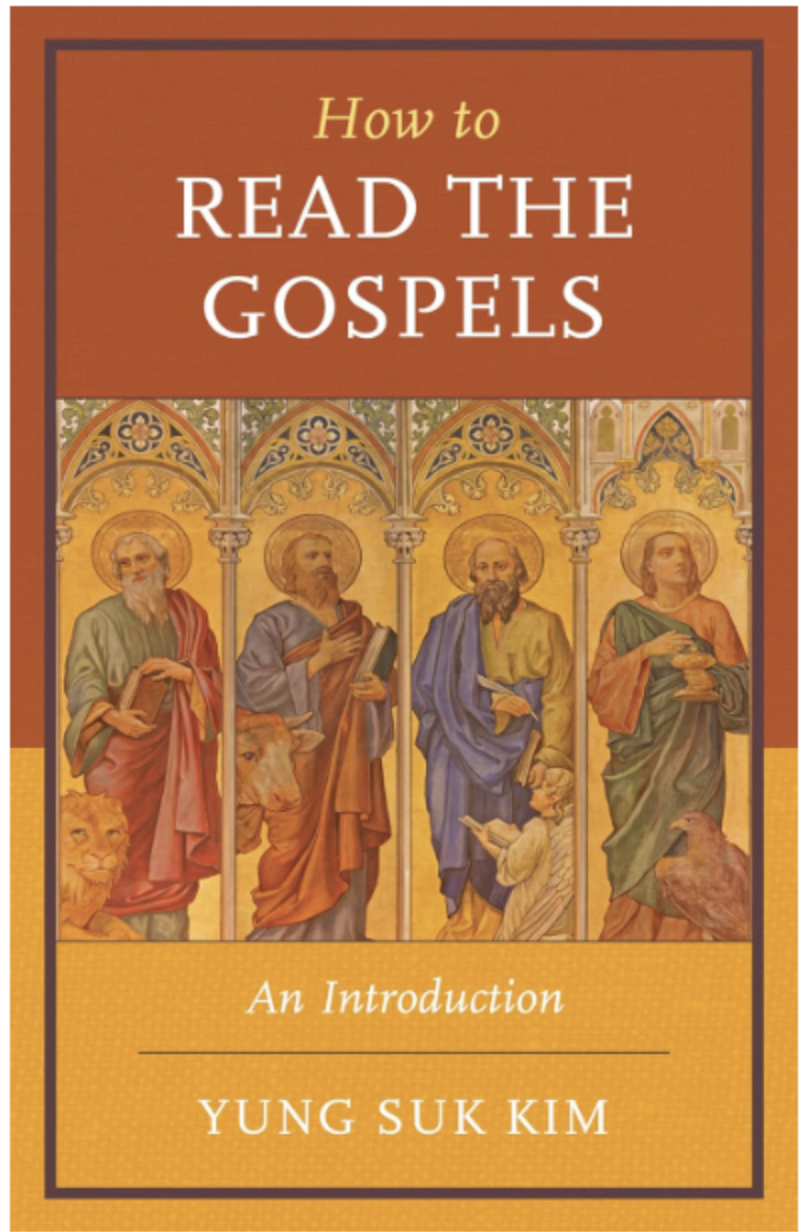
“Never judge a book by its cover.” This was certainly true for me with Yung Suk Kim’s groundbreaking book, How to Read the Gospels: An Introduction. While waiting for the review copy to arrive, my expectations were low because I had read many introductions over the past two decades and had come to assume, ‘It will be another introduction to the Gospels.’ However, I was proven wrong. Upon opening the book and skimming through its contents, I found myself repeatedly thinking, ‘I’ve never seen anything like this.’
An organizational genius of this book is Kim’s approach of reading each Gospel twice. In Part 1, Kim provides a close reading of each Gospel—Mark, Matthew, Luke, and John—offering an introduction from both historical and literary perspectives. In Part 2, he explores each Gospel through various lenses, ranging from traditional methods such as historical-critical and narrative criticism to contemporary approaches like inter(con)textual and ecological criticism. This innovative and bold structure offers readers two options: they can either read Part 1 and Part 2 “in sequence” or study them “together” when examining a specific Gospel (p. 3). This comprehensive introduction is made possible by Kim’s belief in three layers of interpretation in the Gospels: 1) “As the story of Jesus”; 2) “As the story of the Evangelist reflecting on the significance of Jesus”; 3) “As the story of Jesus and the Evangelists for contemporary readers.” For those familiar with traditional methods and skeptical of contemporary approaches, Kim, as a pastoral scholar, reassures readers: “People from diverse backgrounds and cultures still love to engage with the stories of Jesus to explore authentic faith or moral guidance” (p. 13).
In Part 1, the organizational structure of the book remains largely consistent: 0) Introductory Remarks; 1) The Markan/Matthean/Lukan/Johannine Jesus; 2) Distinctive Theological Themes; 3) Parables in Mark/Matthew/Luke; 4) Notable Interpretive Issues; 5) A Close Reading of Mark/Matthew/Luke/John; 6) Questions for Reflection; 7) Further Reading. Since John’s Gospel contains no parables, Kim replaces this section with “‘I AM’ Sayings of Jesus” (pp. 111-112).
In Part 2, before delving into each Gospel, Kim provides an overview of interpretive approaches for those who are unfamiliar with them. His survey is so succinct and compelling that I found myself eager to jump ahead to the sections where he examines each Gospel using these methods. To offer a comprehensive and distinctive overview, Kim categorizes the different methods into three criteria:
- Author-Centered, Historical Approach: Historical-Critical Method and Social-Science Criticism.
- Text-Centered, Literary Approach: Textual Criticism and Narrative Criticism.
- Reader-Centered, Comprehensive Approach: Reader-Response Criticism, Feminist Criticism, Womanist Criticism, Ekklesia-Centered Theological Interpretation, Jewish Interpretation, Inter(con)textual Interpretation, Queer Criticism, Postcolonial Criticism, Deconstruction Interpretation, Minoritized Criticism, Disability Studies, and Ecological Criticism.
According to Kim, these divisions are “not absolute or definitive but flexible” (p. 136). By reading and interpreting each Gospel through the aforementioned approaches, Kim demonstrates that the Gospels can be read in various ways, rather than adhering to a single interpretive method.
Kim’s revolutionary introduction offers several benefits that readers will appreciate. First, it allows readers to compare and contrast how a particular theme or text can be examined from different perspectives. For example, how does the historical-critical method explore the messianic secret in Mark? How does this differ from the approach of narrative criticism? Additionally, how does a Feminist reading of the story of the Syrophoenician woman compare to and contrast with a Womanist reading?
Second, readers are invited to gain new insights from diverse readings to which they may be unfamiliar. For instance, Queer Criticism left me particularly amazed: “He [Joseph] violates the custom (cf. Dt 22:23-27) and marries her…But the text says he did a righteous thing—that is a queer thing” (emphasis added, p. 183). I especially appreciate that Kim includes Jewish Interpretation, which many Christian readers might not otherwise encounter, and that he introduces Inter(con)textual Interpretation, which features enlightening and inspiring stories of real people and their struggles to live out their faith.
Third, Kim’s book serves as an excellent guidepost for further exploration. For instance, the “Consider and Discuss” sections delve deeper into intriguing verses and themes found in the Gospels, such as “His blood be on us and on our children!” in Matt 27:25 (p. 71) and “You are from your father the devil” in John 8:44 (p. 121). Additionally, in Part 2, Kim provides recommendations for “Further Reading” for those interested in exploring specific approaches to the Gospels—whether it be Postcolonial Criticism applied to the Gospel of Mark or Disability Studies applied to the Gospel of Luke.
Despite the substantial contributions Kim’s work makes to scholarship and to students of the Bible, this introduction also leaves readers somewhat unsatisfied. First, the various perspectives presented in each Gospel are too brief. For example, while discussing the Historical-Critical Method in Mark’s Gospel, Kim introduces concepts like “the messianic secret” and “Jesus’s baptism” to explore Mark’s Christology. Many other themes and texts could be interpreted using this method but are not included, although I acknowledge that the scope of the project is too large to cover everything.
Second, certain major topics (e.g., the messianic secret) or specific stories (e.g., the story of the Syrophoenician woman) receive disproportionate attention. While this is understandable given the constraints of the work, it leaves me wondering, ‘What about other stories?’
Lastly, and most importantly, there are rarely any counterarguments presented in Part 2, where Kim provides examples of specific readings of the Gospels. For instance, while introducing Ukpong’s Inter(con)textual Interpretation, the book states, “Luke’s message…portrays Rome as politically correct” (p. 206). This is a misreading of Luke and could mislead readers. Luke is the only Gospel that includes Satan’s statement, “I give it [the glory and the authority of the kingdoms of the world] to anyone I please” (Luke 4:6). According to Luke, the glory and power of Rome are granted by and pleasing to Satan. The Roman legal system, though it protects Paul in Acts (e.g., Acts 16:37; 22:25; 23:23-24; 24:26), is depicted as flawed. Counterarguments could have enriched the discussion and broadened readers’ perspectives.
Yet, Kim’s groundbreaking work deserves much praise and attention because it has accomplished something unprecedented—reading each Gospel side by side from various perspectives. I am convinced that he has achieved his ambitious goal: “to encourage readers/students to read the Gospels closely and diversely” (p. 239). Above all, the most exciting and adventurous proposal Kim makes is, I believe, his suggestion to make the Gospel texts living stories: “we need to revisit the stories of Jesus from our modern-day context and tell our stories in response to them” (p. 244). Kim has not only showcased this approach but has also embodied it in his book. For that, I am deeply grateful. I highly recommend this book not only to seminarians and scholars of the Bible but also to anyone who seeks to read the Gospel for knowledge, personal growth, and even spiritual development.
Hyun Ho Park
First United Methodist Church of Yuba City
=== Response from the author
First of all, thank you for reviewing my book. I read your comments quickly, and you made a lot of good points, which I truly appreciate. I acknowledge your critique regarding the insufficient representation of each perspective in the gospel methods. However, I do not share your grave concern about “a misreading of Luke and the readers.” I intended to exemplify various readings of each Gospel. For instance, Ukpong’s reading is his interpretation, while other readings may or may not reflect Luke’s anti-imperial position, depending on their interpretive perspectives. Indeed, from certain viewpoints, Luke appears to be a social, anti-imperial gospel, while it can also be construed as a peaceful gospel. My book does not take a stance on either interpretation; it simply presents a variety of gospel methods.
Categories: (B) Book Review
 Asian American Theological Forum
Leave a comment