
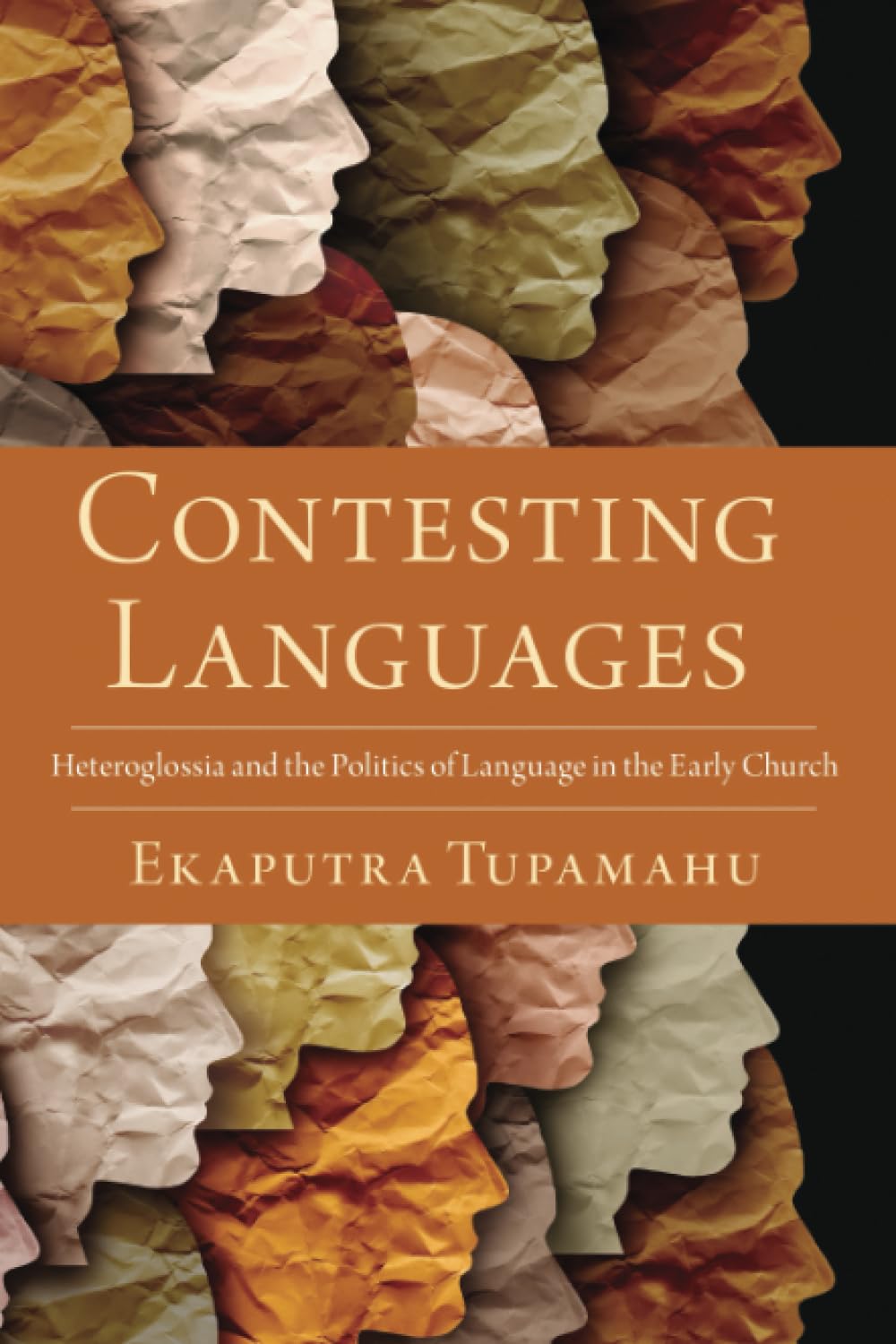
What happens when “divine speech” must pass through human tongues?
In Contesting Languages, Ekaputra Tupamahu challenges the dominant claim that Paul’s discussion of “tongues” in 1 Corinthians refers primarily to ecstatic or angelic speeches. Instead, Tupamahu argues that Paul is talking about ordinary human languages. The book opens with a reception history and reinterpretation of glossolalia, tracing the shift from the “missionary-expansive” interpretation of tongues as ordinary human languages (from Irenaeus to 19th-century theologians) to a (German) “romantic-nationalist” interpretation of tongues as angelic speech or ecstatic utterances (beginning from Herder in the late 18th century). The “missionary-expansive” tradition understood tongues as a sign of faith crossing linguistic and cultural boundaries, whereas the “romantic-nationalist” tradition understood language as an expression of a person’s inner spirit, making language more of a divine inspiration than of communication (pp. 12-48).
Tupamahu then draws on Mikhail Bakhtin’s theory of heteroglossia to locate Corinth as a socially and linguistically diverse city. By bringing Bakhtin’s theory with historical evidence about Corinth’s cosmopolitan context, he portrays the city as a place where minority and dominant languages constantly interacted and shaped one another. Within this multilingual context, Paul’s regulation of tongues in worship reflects his uneasiness toward minority languages that are unfamiliar to him. In 1 Cor. 14:2, when Paul says “for no one understands them” (p. 127), Tupamahu argues that it refers to the hearers and not the speech/language itself. Since Paul likely cannot understand these minority languages, he privileges the dominant Greek-speaking audience, effectively marginalizing and silencing the minority language speakers. The regulation of “tongues,” therefore, serves as a tool of linguistic control that sidelines minority voices and diverse linguistic expressions.
Tupamahu further says that Paul uses three political strategies of race, gender, and imperialism to silence minority languages in the Corinthian church (pp. 142-184). Paul’s use of the word barbaros in 1 Cor. 14:11 (“foreigner” or “non-Greek”) functions as a racial marker that labels minority language speakers as outsiders or inferior. The word barbaros (from which the English words “barbarian” and “barbarous” come) was originally used to distinguish Greeks from those whose languages they could not understand, making linguistic difference a tool for exclusion and hierarchy (pp. 146-156). As Tupamahu notes, “The Greeks see these people as speaking bar-bar-bar, or in English bla-bla-bla, because their speech sounded like gibberish to the Greek’s ears” (p. 116), showing how linguistic difference functioned (and continues to function) as a tool of hierarchy and racism. Additionally, in 1 Cor. 14:34-35, Paul uses a gendered analogy by associating minority languages with women, portraying them as subordinate and less authoritative compared with the dominant (male-coded) language. For instance, Paul commands women, and by analogy, foreign language speakers, to remain silent in church and to ask their husbands at home if they want to learn, essentially channeling their speech through male authority (pp. 157-174). Lastly, Paul’s mandate for linguistic conformity (enforced through translation and justified with the rhetoric of peace) is a reflection of imperial control because it mirrors how Roman authorities privileged (Greek) language to control, unify, and silence minority populations (pp. 175-180).
As a counter-narrative, Tupamahu then highlights New Testament writers who resist Paul’s mandate for linguistic unification. In Acts 2:4-11, Luke describes the Pentecost as an event where those gathered there spoke multiple languages without requiring translation. Additionally, the writer of the extended ending of Mark (Mk. 16:9-20) affirms multilingual speech in Jesus’ final commission before his ascension. Both narratives resist Paul’s exclusive approach, affirming and encouraging the multiplicity of languages (ch. 6). Tupamahu concludes the book with an “inconclusion” to deliberately reflect the true nature of heteroglossia, allowing space for linguistic diversity and the perpetual presence of otherness. Language and its interpretation are never neutral; they are inherently political. Tupamahu makes this point brilliantly in his book. His use of Bakhtin’s theory of heteroglossia offers a powerful lens for critiquing the politics of language.
While the book references postcolonial and decolonial thinkers throughout, a deeper or more direct engagement with non-Western and Indigenous language theories could further strengthen his framework, helping to decenter Euro-American paradigms. In his dissertation (Tupamahu, 2019, pp. 141-151), he specifically examines the politics of language in the Indonesian/Javanese context, demonstrating how Javanese speech varieties like krama-inggil (formal, high-level Javanese) and ngoko (informal, everyday speech) are socially stratified, performative, and relational rather than purely abstract systems. Drawing on Indonesian scholarship, Tupamahu emphasizes that Javanese language varieties such as krama-inggil and ngoko reflect social relationships more than literal meanings, illustrating how language is culturally situated, socially embedded, and politically charged. Although this discussion is largely absent from his published book, possibly due to editorial or audience considerations, the omission is significant for a project committed to postcolonial critique. His engagement with Javanese language politics powerfully challenges Euro-American linguistic assumptions and centers non-Western perspectives. As a scholar in the U.S., shaped by Indonesia’s linguistic and cultural complexities, including this material would have enriched the theoretical and contextual arguments of the book.
Nevertheless, in a world where language and accent affect access to credibility, recognition, and power, Contesting Languages is an essential read. Understanding the linguistic politics is especially important in contexts where the English language and its “proper” usage often stand in for proximity to whiteness. The coloniality of language demands that we keep asking these questions: What languages matter and why? Whose speech is marked as “unintelligible” or “inferior,” and on what grounds?? And who gets to decide what counts as the “standard” or “sacred”?
So, what happens when “divine speech” must pass through human tongues? This book offers an unsettling but essential answer that divine speech does not pass through human tongues unaffected. It gets translated, “purified,” and often silenced by systems of power. This is specifically why the political nature of language and its interpretation demand our attention.
Yajenlemla
Drew University
Categories: (B) Book Review
 Asian American Theological Forum
Leave a comment