
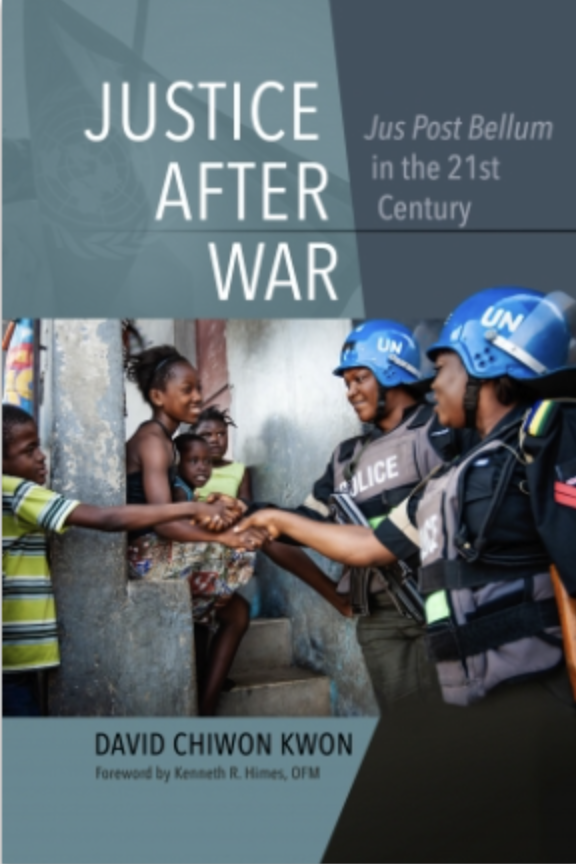
Many will remember the withdrawal of U.S. troops from Afghanistan on August 30, 2021, which resulted in the loss of 13 U.S. servicemen and more than 22 Afghan allies. Yet, not many realize that the U.S.-Afghan War dates back to 1999 and played a role in causing the infamous 9/11 attacks. I recall the images and cries of Afghan allies asking for help, knowing that their security was no longer a priority for the incoming Taliban regime as U.S. troops withdrew. This is not an isolated instance of post-war tragedy. Regardless of one’s political standpoint or judgment, the ongoing conflicts in Ukraine and Israel/Palestine once again highlight who the most vulnerable are—not only during the war, but also in its aftermath: the civilians of the defeated party or nation, who lose their homes, families, and livelihoods.
In this regard, David Chiwon Kwon’s book is a welcome addition to the much-needed political and practical debate on war and peace in our time. “You can win the war but lose the peace,” says Kenneth R. Himes, Professor of Theology at Boston College, in his preface to Kwon’s book (p. xi). This is a critical and urgent issue because, as Professor Himes puts it, “a bad peace can encourage a future war” (p. xiii). We have witnessed such a “bad peace”—or an unsatisfactory peace for one or both parties—and its consequences in the Hamas attack on October 7, 2023, and the subsequent Israel-Hamas war. As the wars in the Middle East and Ukraine wind down, a question emerges: what will happen after the war ends? How can peace and justice be restored in the post-war society—whether in Gaza or Ukraine?
Whereas traditional Just War Theory (JWT) focuses heavily on jus ad bellum (jab: the justice or reason for war) and jus in bello (jib: justice in war), Kwon shifts the emphasis to jus post bellum (jpb: justice after war). He points out that the current discourse on jpb is so focused on political reconciliation that it often overlooks human security. True peace, he argues, is not merely the absence of war but the establishment of justice. Kwon contends that achieving justice after war (jpb) for the common good requires two moral visions: human security and political reconciliation. These two visions can be realized through just policing, just punishment, and just political participation. To this end, Kwon employs the framework of the “maxim(um) of ethical minimalism,” which seeks to maximize the common good and human security while minimizing the use of violent means.
Kwon’s work is divided into two parts. In Part One, he investigates a theory of jpb for moral theology. In Chapter One, Kwon lays the foundations of jpb by drawing from the works of Aristotle, Aquinas, Walzer, and Orend. Chapter Two discusses three key discourses: 1) the debate between the traditional “right to fight” position and the emerging “responsibility to protect people”; 2) the debate between minimalist and maximalist approaches; and 3) the middle ground between these two extreme positions. Chapter Three delves into why theology matters to human security in the post-war context. Chapter Four explains how his framework of the “maxim(um) of ethical minimalism” enhances the common good and restores justice. Whereas Part One deals with theory and theoretical issues, Part Two addresses policy-oriented and practical concerns in jpb. Chapter Five explores the need for, and the challenges of, just policing in peacekeeping and nation-building. Chapter Six discusses the foundations, scope, and practice of just punishment to amend past wrongdoings and secure the rule of law. Chapter Seven examines how just political participation contributes to peacebuilding in civil society and helps reconcile the future hostility that often arises after war.
Besides his in-depth theoretical engagement with classical and contemporary thinkers, the following four aspects of Kwon’s work deserve recognition. First, Kwon deserves praise for offering “moral clarity concerning jpb efforts in the Christian JWT” (p. 6). As witnessed in recent conflicts, such as the Iraq War (2003–2011) and the Afghan War (1999–2021), how to end a war is just as important as how to begin and conduct it. Kwon offers a solution to this conundrum in the form of a tripod of jpb: just policing, just punishment, and just political participation.
Second, Kwon shifts the discussion of jpb from an ideal slogan—political reconciliation—to a practical framework: just policing, just punishment, and just political participation. It is hardly surprising that the cry for reconciliation often falls through the cracks, because war is messy. The law of nature, in which the winner takes all, can be cruel, devastating, and detrimental. Without (re)establishing the rule of law and a concerted effort for peacebuilding, the defeated can be thrown into a “hell in a handbasket.”
Third, Kwon demonstrates and revives the Niebuhrian ethic of love and justice in action. Protests and demonstrations fill the campuses and streets, yet wars continue, whether it is the Israel-Hamas war or the Ukraine-Russia war. The cry for compassion for Palestinians or for the sovereignty of Ukraine does not change the reality of war, because such slogans hardly find room to breathe in international relations, just as justice often trumps—if not tramples—love in the public sphere. Kwon’s honest appraisal of Niebuhr’s dictum rings true: “Justice is an attempt to balance one man’s sinful self-interest against the sinful self-interest of others in society” (p. 250). This is precisely why he emphasizes just policing, just punishment, and just political participation in order to protect human security and procure the common good.
Fourth, Kwon urges his readers to think about Christian discipleship in the context of jpb. Throughout history, Christians have often been either ardent supporters of war or indifferent spectators of it. Furthermore, their enthusiasm typically subsides once the war ends or the media no longer provides coverage. But Kwon’s book is a wake-up call for slumbering Christians: “The mission of the Church post bellum is to be people of God by working on behalf of God’s plans and purposes for the (re)establishment of a just peace on earth” (p. 6).
Despite the aforementioned contributions to the jpb discussion, Kwon’s work also has some limitations. As he mentions in the conclusion of his book, first, his work focuses on interstate warfare, whereas wars and conflicts are increasingly “civil, ethnic, and communal,” as Lisa Sowle Cahill puts it (p. 268). How can just policing, just punishment, and just political participation be possible in a post-bellum context when the goal of war is ethnic cleansing or the decimation of one people group within a nation? Second, his tripod of jpb seems powerless in the face of the law of nature. If the unjust party wins the war, where is justice in the first place? Can the United Nations or faith-based civil society organizations have a say in post-bellum affairs? Third, though morally compelling, the absence of war is often more enticing than the establishment of justice when considering the cost of war. Even a regional war impacts the lives and livelihoods of many across the globe, from electricity and gas prices to food prices—especially for the poor and marginalized. Can justice ever truly prevail at all times?
Even with the above limitations, I believe Kwon has effectively demonstrated the need for justice after war and how it can be accomplished. In addition, his book convincingly argues that human security should be the utmost priority in the peacebuilding and reconciliation process. I highly recommend Kwon’s captivating work not only to scholars and students of Just War Theory but also to anyone interested in the ethics and theology of war, justice, and peace.
Hyun Ho Park
First United Methodist Church of Yuba City
Categories: (T) Book Review
 Asian American Theological Forum
Leave a comment