
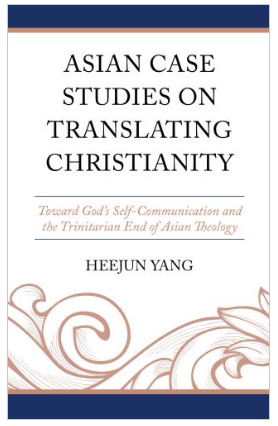
Christian theology and history have often been taught as if Christianity was a Palestinian Jewish sect that migrated only westwards, was Constantinianized and transformed into Christendom, before 16th-20th centuries of Empire-building by European and North American powers brought the gospel to the rest of the world. Even the Chinese “Back to Jerusalem” evangelistic movement, which sought to bring the gospel to the western reaches of the Asian continent, makes that assumption. Consider how in teaching the doctrine of the Trinity, the traditional approach often begins with the Church Fathers and their engagements with Subordinationism, Adoptionism, Sabellianism, and most famously, Arianism before arriving at the Council of Nicea in 325 CE. Heejun Yang’s book, in light of this Weltanschauung, interrupts this traditional approach, reminding us how, despite our theological or historical approaches to conform God into our own ideological, cultural, or sociological prisons, God has often broken free and this obscured history confounds our theological elocutions and logics.
Yang’s book makes two related arguments. First, the Trinity forms the basis and end for Asian theology, and second, the way different Asian churches have contextualized the Trinity presents Asian theology as an exercise in unity amidst diversity. This book is, in some senses, a follow-up to his earlier book, Trinitarian Responses to Worldliness (Pickwick, 2022) where Yang argued that the Trinity needs to be the ground for inculturating the gospel into various contexts so that theology neither rejects “the world” nor reifies it. At the same time, the Trinity is also the end of theological inculturation. The transcendent God who reveals and communicates Godself diversely reconciles all to Godself and, in doing so, allows for the possibility of all people being reconciled to each other. In Asian Case Studies, Yang provides a deeper analysis of how the triune God self-communicates in East Asian cultures through four contextual case studies: Jingjiao Christianity, Matteo Ricci’s missionary work, Korean Christianity (focusing on Choe Byeong-Heon’s theology), and then Asian American Christianity. Through these case studies, Yang traces the ingenious ways in which local churches tried to understand the Trinity and make it their own. Yet, in a way that is reminiscent of Thomas Aquinas’s exitus reditus dynamic in his theology, the triune God speaks into a variety of contexts, but these contextualizations nonetheless find harmony in God.
A few points should be made about the book. First, as the title suggests, it consists of case studies. Historians will, no doubt, find issues to quibble about the way the case studies were used. The case study of Matteo Ricci as an example of Chinese inculturation is an interesting move. Certainly, he and his missionary colleagues were active in finding points where Christian theology could intersect with Chinese culture, but this does not imply that the Church in China would necessarily agree with it. A stronger case might be made for Chinese Christians who were contemporary to Ricci interpreting their faith and integrating it into their Confucian worldviews. As an example, one of his converts, Xu Guangqi, formulated his own interesting contextualization of Confucianism and Christianity which, as some argue, is really an argument for how (Nicene) Christianity is the ultimate fulfillment of Confucian ideals.[1] The case study on Asian American Christianity curiously made no mention of the Yellow Power Movement in the 1960s, which gave rise to the idea of Asian America as a unique identity and was the source of the first wave of Asian American theological reflection from scholars such as Paul Nagano, Fumitaka Matsuoka, and others.
Second, the choice of case studies raises a further question: the cultures represented – Chinese, Korean, East-Asian-American – are also cultures touched by Confucianism. One could ask whether the inculturation of the Trinity into East Asian contexts was facilitated because there are convergences between the philosophies of Confucius and Aristotle. (The Trinity, it must be remembered, makes use of Aristotelian categories.) While an exhaustive compilation of various case studies would make the book unwieldy, an opportunity to demonstrate the diversity of Asian cultures beyond China and Korea has been missed. It would be interesting to hear of how the Trinity was interpreted and contextualized by figures such as Brahmabandhab Upadhyay or Sadhu Sundar Singh, and whether they would still support or complicate Yang’s thesis. Additionally, the inclusion of these figures would’ve better accentuated the diversity of God’s self-communication to “Asian” churches.
But third, the critiques should not diminish the two major strengths of Yang’s book. Yang’s case studies do introduce and analyze stories that, I would wager, readers in the West would not be familiar with, with the possible exception of Matteo Ricci. Certainly, I have not been exposed to Choe Byeong-Heon before reading Yang’s text. He successfully demonstrates that the Western narrative of interpreting the triune God was not the only one which, in turn, is a testament to Christianity’s vibrancy. For this reason, this book can be useful for survey courses in Asian theologies. Yang’s book also remembers the importance of grounding Christian theology in the triune God and demonstrating how the concept, which can be extremely abstract and hard to grasp for introductory theology students, was concrete and personal to local contexts. Each of these case studies, or the book as a whole, can be helpful in introductory theology courses for that reason. In any case, Yang’s book should not be the final word on how Christianity is translated into local contexts. Perhaps a worthy challenge for readers of this review would be to excavate ways in which local, lesser-known theologians have translated Christianity for their situations and see for themselves that, as the Chronicler has aptly written about God, “All things come from you, and of your own have we given you.” (1 Chron. 29:14)
Henry S. Kuo
Eden Theological Seminary
[1] See Anna Seo, “Xu Guangqi’s Thought on Supplementing Confucianism with Christianity,” Lingua Cultura 6, no. 1 (2012): 108-116. DOI: 10.21512/lc.v6i1.398
Categories: (T) Book Review
 Asian American Theological Forum
Leave a comment