
Introduction
When I wake up each morning, the first thing I do is scroll through social media feeds. Living in Hong Kong (GMT +8), I generally sleep during late afternoon in Europe (GMT +0/+1) and throughout the day in North America (GMT -4/-7). Many of my acquaintances, colleagues, and friends who are originally from Hong Kong now live in these areas, so my social media scrolling allows me to catch up on what has happened during their waking hours. I imagine this is not unique to me. Since the Anti-Extradition Amendment Bill protests (Anti-eLAB) from 2019-2020 and the subsequent implementation of the National Security Law in 2020, many Hong Kongers have migrated to places such as Taiwan, Britain, Canada, America, and Australia. A survey says that over half of Hong Kongers interviewed stated that, in the past three years, they have thought of leaving Hong Kong for good.[1] A census in 2021 found that over 60% of churches have congregants who already migrated abroad, and 80% of churches have congregants planning to migrate abroad.[2] This has created large diasporic Hong Kong communities that share their lives and thoughts through social media networks with those around the world, including those who remain in Hong Kong.
Frequent interactions with others residing outside of Hong Kong is, of course, part of Hong Kong Christian communities’ lives. Facilitated by the digital age, easy access to online platforms now allows for lay Christians, locally or in the diaspora, to lead the trend in Christian communities. Previously, Hong Kong Christian churches tended to be hierarchal due to Christianity’s introduction alongside colonial rule. As the Christian church grew alongside the colonial government, foreign, usually white, missionaries tended to run these churches, while local Chinese Christian pastors typically delayed ordination, usually close to their retirement, because white missionaries, among others, felt the need to ensure their Chinese counterparts did not abuse power or to ensure they were true believers.[3] This has continued to present day—even though most pastors in Hong Kong, ordained or otherwise, are ethnically Chinese, ordination still comes much later in their career than that of, say, their white North American counterparts. This has affected how power and authority are perceived in Hong Kong Christian communities, with star pastors and Christian leaders having esteemed social standing and being considered to best represent the voices from Christian communities, while your average Joe’s theology is swept under the rug, as they are not as refined or articulate. British practical theologian Pete Ward finds this phenomenon in general to be problematic, as he states,
Theology that is found in communities and in the lives and experiences of individuals comes in forms and types of expressions that are much more varied than a written academic text. […] Qualitative research takes seriously the notion that it is in the lives of communities and individuals that we find the natural environment for theology where it is energized by the work of the Spirit. At the same time, it is also important to acknowledge that the theological data generated by fieldwork is often ambiguous and sometimes contradictory, and occasionally incoherent. This quite simply reflects the messy nature of theology as it exists in cultural expression and community life. For a discipline that often seeks to create systematic accounts of the divine and of human life this can be perplexing, but the very complexity of lived reality is one of the gifts that qualitative research brings to theological work.[4]
Ward’s argument resonates with me because, rather than flattening the narrative by neglecting the messiness of the daily lives of Hong Kong Christians, it is precisely the contradiction and occasional incoherence that is representative of real lived theology.
In recent years, there has been a shift toward average lay Christians leading the trends rather than simply being represented by star pastors or Christian leaders. Steering away from the Western-educated, authoritative Hong Kong Christian voices of Josephine Yan-pui So and Philemon Yuen-wan Choi in the 1970s-1980s,[5] many lay Hong Kong Christians, seminarians, and aspiring non-institutional pastors, such as Galut, Hypersonic Lab, and Ideas Fung, are creatively imagining their expressions of faith within new yet pervasive online platforms.[6] They all began engaging with a general public audience through online platforms roughly around the start of the hashtag #deltaδmovement, which has become a decentralized, collaborative, bottom-up, “priesthood of all believers”-style Protestant Christian community. Hong Kong lay Christians began posting with #deltaδmovement in April 2020, starting a digital trail of Hong Kong Christians’ lay theologies. This hashtag movement began with the younger generation and continues to be self-initiated, creating narratives not controlled by star pastors or theologians but by a multitude of average Christians. Moreover, Protestant Christianity-focused Facebook groups and YouTube channels have been created by and for Hong Kong Protestant Christians, with content posted by influencers and key opinion leaders (KOLs) who would otherwise lack such a prominent voice in these mainstream communities. With such a born-digital record of Hong Kong Christianity, #deltaδmovement provides researchers with a chance to observe theologies of the laity in their own words and ways of expression.
This is why, through this paper, I first analyze posts and comments related to the #deltaδmovement from 2020 to 2023. Then, I explore how Hong Kong and diasporic communities interact and cross-pollinate theologies, especially through social media engagements. Finally, I interrogate how this phenomenon affects wider theological scholarships, such as the rise of digital humanities and issues with the category World Christianity. There is a Chinese saying: “throw a brick to attract the jade” (拋磚引玉), meaning to toss out a work-in-progress to attract more worthy ideas. I hope this paper starts a conversation, especially in Hong Kong Christian communities, that consider how social media, as a disruptive technology, is changing how we interact with friends, family, and strangers.
What Makes #deltaδmovement?
I will first analyze selected Instagram and Facebook posts and comments related to the #deltaδmovement from 2020 to 2023. By employing an ethnographic approach to digital field observation and posts/comments analysis, I articulate how Hong Kong Christians portray their faith and engage with others online, and how such engagements and forms of expression shape their theologies apart from a Christian leader speaking on their behalf. While posts in the #deltaδmovement are diverse, they share at least one of several critical features: (1) a captivating image with long chunks of text, (2) use of biblical scriptures, and (3) a low barrier of entry, creating KOLs. These points demonstrate how Christian identity integrates with ways of expression in Hong Kong online communities.
A Captivating Image with Long Chunks of Text
Posts on Instagram always include an image, as that is a requirement of posting anything on the platform. As such, Hong Kong Christians have taken this up and created captivating images. One aspect that makes #deltaδmovement posts stand out is the amount of text in the images themselves. As we can see from the screenshot below (see Image 1) taken on October 1, 2023, most images have a great deal of text on them. Jesus Online’s founder Anson Tang and Tuen Mun Alliance Church’s Senior Pastor Shu-yi You (游淑儀) point to social media platforms as a vessel to hold God’s Word.[7] #deltaδmovement demonstrates not only an attractive visual, such as that of influencers posting themselves or food or a landscape, but also that communicating through written text is important to those using #deltaδmovement. This reflects post-Reformation Protestantism in Hong Kong, where biblical texts are elevated over other experiences of the Christian faith.

Image 1: Screenshot Illustrating Captivating Images with Long Chunks of Text (Captured on October 1, 2023)
In 2023, Beacon College surveyed the use of social media among young people. Among Hong Kong students, over 93% use Instagram, while just over 48% use Facebook.[8] Cyril Cheung, the director of Hong Kong General Chamber of Young Entrepreneurs, argues that the rise of Instagram and the decline of the use of Facebook is due to youth preferring images and videos over text.[9] I find their immersion in the medium and respect for its format, that is, image-centric, is a big part of their posts becoming widespread and being taken up by non-Christian Hong Kongers on Instagram. Asian American theologian Sunggu A. Yang shares the same conclusion in reflecting on online preaching, as he sees it as different from conventional preaching, with its own techno-theological reasoning and unique ways of social communication.[10] Had Hong Kong Christians simply posted text with dates and times of events like on a bulletin board, for example, that would be more like a conventional church bulletin and would not have been as impactful or effective as it is now through personal and engaging storytelling. It is through what is considered to be the genuine sharing of life and faith that leads readers into the world of the posters.
Use of Biblical Scriptures
The use of biblical scriptures is prevalent in #deltaδmovement. As we can see from the screenshots below of two #deltaδmovement posts (see Images 2 and 3) taken on October 1, 2023, the first is actually a restaurant review by a medical nurse who is also a food enthusiast, where the poster adds biblical verses at the beginning and reflects on the verse before getting to the restaurant review. The second post is from The Voice (低聲道), an online media arm of Hong Kong local Christian newspaper Christian Times, who shares the prayer letter of a pastor who is also the father of a local supporting dancer who had been critically injured during the concert performance of a renowned local boy band, Mirror. Biblical passages are also used in this prayer letter, as is common in prayer letters. In these instances, they share their thoughts on biblical verses and how these verses relate to their lives, reflecting the real-life interactions of churchgoers in fellowship settings. This online replication, with commenters interacting with their texts, shows a certain level of interaction among those who consider themselves to be Hong Kong Christians. Chinese YMCA of Hong Kong’s Institute of Christian Ministry’s Lecturer Ben Ho sees the medium of social media and Christian faith interacting and affecting each other.[11] In a sense, these social media exchanges create a space outside of the brick-and-mortar church where Hong Kong Christians, especially unchurched ones, are able to engage with Christian communities and continue to demonstrate their faith convictions. Hong Kong Australian theologian Caroline Yih analyses the experience of being an unchurched Christian, while losing a tight-knit institutional church community, she finds “a new home outwith the institutional community in the secular, messy, uncertain, and fractured world.”[12] While Yih is referring to the secular world at large, the sense of messiness and uncertainty is also representative of social media spaces.

Image 2: Screenshot Illustrating the Use of Biblical Scriptures in a Restaurant Review Post (Captured on October 1, 2023)

Image 3: Screenshot Illustrating the Use of Biblical Scriptures in a Prayer Letter Post (Captured on October 1, 2023)
Users’ interactions on social media, a public space, demonstrate their presence. Hannah Arendt coined the idea of the politics of appearance, where consistent human actions in public spaces are political statements, in this case, through posting with biblical passages on social media. Arendt sees the public space as arising out of the actions and speeches of individuals, and this space is fragile, volatile, and exists only in the actualization of the performance.[13] Demonstrated by the use of scripture, this action creates a space for Christian presence in a seemingly neutral, non-religious space. Canadian pastors Jason Byassee and Andria Irwin argue that, in a postmodern Western society that thrives on a consumerist mentality and value system, scriptures stand countercultural to what our actions profess we value. Byassee and Irwin find that religion cannot be separated from the media we participate in, and Christians’ participation in new media is not something to be done out of obligation to remain visible in the contemporary world, but a meaningful utilization of these media is to shape and disciple people.[14] Their argument is represented in #deltaδmovement’s posters, who integrate scripture and reflections with food blogs, not trying to be relevant but, rather, attempting to interact with, shape, and disciple others.
A Low Barrier of Entry, Creating Key Opinion Leaders
In general, most #deltaδmovement posts have a couple of hundred likes, meaning many have engaged with, or at least scrolled past, their posts. While everybody can participate in #deltaδmovement, allowing for anyone who wants to participate to take part in shaping the conversation, it is a vast sea of information that disappears very quickly. Institutions like The Voice have the resources to post repeatedly and create more content, which allows them to capture a larger audience and gain more traction in shaping the conversation. For individual posters to have an equivalent impact, they need to create their own strategic plans in posting on social media. Digital anthropologist and sociologist Gabriele de Seta finds that being in the digital field requires being continuously online, visible, available, and interactive, which makes it a social rather than technological issue.[15] These aspects of interactions should be analyzed in detail, even if the poster and the commenter may not have given so much thought to their interactions. I aim to further investigate this point in my upcoming research project.
#deltaδmovement has facilitated the rise of seminarians and laity as KOLs, shaping the conversations Hong Kong Christian communities undertake. The low barrier of entry has allowed lay Christians to influence the discussion, as long as they are able to post consistently and respect the medium. Respecting the medium could mean engaging as a friendly voice rather than a news bulletin, as official institutional church social media accounts usually do. For example, a Hong Kong-based theologian John Chan wrote about German theologian Dietrich Bonhoeffer,[16] Rocky Yeung, PhD candidate at the University of St Andrews’ School of Divinity, wrote his response on his Facebook page and eventually was published in Christian Times.[17] By responding to Chan on Facebook, Yeung contributed to a conversation among Chan, himself, another Hong Kong-based theologian Keith Chan, and America-based biblical scholar Sam Tsang, which dominated the discourse of Hong Kong Christian communities at the time. I would say that overseas educated PhD candidates are quite common in theological circles, and their voices would not be as prominent without the support of social media. Of course, these KOLs are also self-selected groups, as they are people interested in reflecting on issues and writing about them, engaging with others, and disseminating their viewpoints. Content creators are a unique bunch, different from those who are merely sharing content others create. Nonetheless, with social media breaking down barriers to Christian discussions, it has allowed their voices to become more prominent and drive the conversations in the communities, a possibility not available before social media became pervasive.
Cross-Pollination of Theologies
Technology has also allowed for the cross-pollination of theologies, as shown in Yeung’s discussion with Chan, crossing geographic boundaries not only because Yeung lived in St Andrews at the time, but also because Chan completed his Doctor of Theology (ThD) research on the late German-Swiss theologian Karl Barth in Ruhr-Univerität Bochum, Germany. Yeung also studied under the supervision of the late German theologian Christoph Schwöbel, so their conversations included Hong Kong, Britain, and German theologies, among other topics. I will now explore how Hong Kong and diasporic communities interact and cross-pollinate theologies, especially through social media engagements. This moves beyond #deltaδmovement’s immediate vicinity, as they do not necessarily use the hashtag all the time. Nonetheless, these examples demonstrate lay leadership shaping Christian communities’ discourses, which are very much in line with #deltaδmovement’s objectives. In previous generations of migration, Hong Kong Christians tended to export their theologies to diasporic communities. With advancements in social media interactions, theologies in Hong Kong and the diaspora have now become mutually transformative.
Example 1: Cultivating Peace – Comments Section as a Space for Conversation
For the first example, on January 25, 2021, Hong Kong philosopher of religion Andrew Wai-luen Kwok co-founded the Cultivating Peace project, a project organized by the Centre for Sino-Christian Studies of Hong Kong Baptist University and the CEDAR Fund, which aims to promote the idea of societal peacebuilding for reconciliation and transformation. The program allows for secondary school and university students to reflect on the meaning of peace by participating in social service initiatives, social studies projects, and art activities, and then apply what they have learned in the community. As we can see in Image 4, on September 2, 2022, Kwok posted on Facebook about peacebuilding with the concept of “sleeping with the enemies,” meaning to continue to live with pain and hurt alongside those who are considered to be enemies.[18] He often posts captivating images with links to articles he wrote for the Christian Times on social media platforms such as Facebook groups, so this is one of many, though this post had more responses than others.
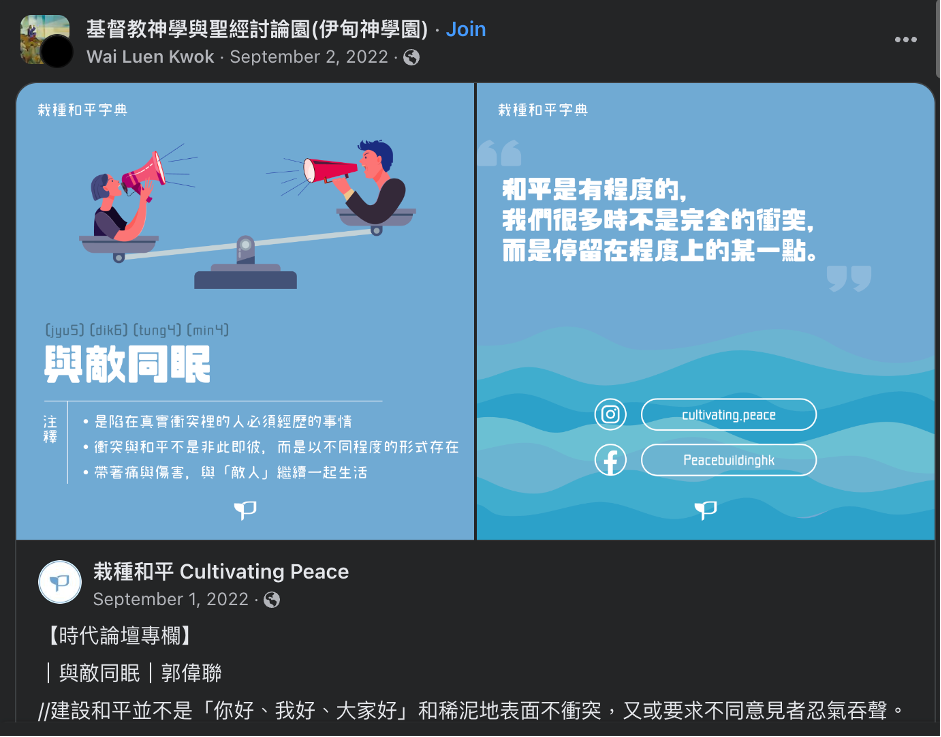
Image 4: Screenshot of Andrew Wai-luen Kwok’s Facebook Engagement (Captured on October 1, 2023)
This post gathered over 40 comments at the time of writing, with many being over a thousand Chinese characters. Many Hong Kong Christians in the diaspora condemned Kwok’s efforts, calling the project “secondary victimization” (二次傷害) of those who participated in the Anti-eLAB protests. Some of the identifiable commenters no longer live in Hong Kong: for example, Yin-ching Chow now lives in Taiwan, and Andrew Ka-po Tan now lives in Britain. While it can be argued that, because they no longer live in Hong Kong, they are less in touch with how local Hong Kongers feel and think, in a more extreme case, perhaps some could even say that they no longer have a stake in Hong Kong issues because they are not willing to remain in Hong Kong and invest themselves locally. Nonetheless, Kwok does not dismiss the commentors as haters or saying that they have no right to speak into the Hong Kong context. Instead, Kwok thoughtfully and peacefully engages and dialogues with these commentors on Facebook, and together, they create an intriguing digital log of Hong Kong theologies in the making, with local and diasporic theologies meaningfully influencing each other. For example, Facebook user Kawabata H Yasunari[19] argues against Kwok based on the following: (1) Kwok made three incorrect assumptions of those who are against cultivating peace, (2) Kwok sees those who are against his methods as being against cultivating peace entirely, (3) Kwok’s understanding of reality is skewed, and (4) living with oppression cannot lead to cultivating peace. Kwok responded to @kawabatahyasunari on these points: (1) Kwok is trying to point out the difficulty in praxis, not dismissing the importance of compensation; 2) Kwok disagrees with calling certain people as being against cultivating peace as a form of defamation; 3) Kwok acknowledges oppression is ongoing and proposes peacebuilding as a process; and 4) Kwok argues the suffering community can empower each other. At the end of the 25 comments between @kawabatahyasunari and Kwok, while they certainly did not come to an agreement, Kwok nonetheless thanked @kawabatahyasunari for providing him with responses and comments, as he finds it important to clarify and discuss these points. Kwok finds that his theologies might lead to negative responses but that being able to clarify and build on the negative responses is a form of cultivating peace as well. Kwok invited further discussion at the end.
I find this sort of discussion in line with #deltaδmovement’s outcomes, that is, providing a leveled playing field for participation of all, that is, Hong Kong-based theologians with Hong Kong pastors, theologians, and lay Christians in the diaspora. These engagements represent Hong Kong Christian communities as they are transitioning toward a more decentralized form of movement where participants consciously strive to respect one another as equal partners in decision-making.
Example 2: Theology Like M Come – Slashers Crafting Live, Online Spaces for Conversation
In another example, the many KOLs in diasporic communities who continue to stream their talks and discussions online have allowed for the cross-pollination of theologies, where Hong Kong Christians who remain are able to also learn from diasporic communities and rethink their theological practices, rather than Hong Kong simply being seen as an exporter of Hong Kong Christianity. For instance, Eddie Au, a Director of Online Media Ministry at the New York Theological Education Centre and currently based in Edinburgh, Britain, and Michael Tang, a PhD candidate at the University of Birmingham, based in London, Britain, together founded a theology talk show called Theology Like M Come on September 4, 2022. As slashers, a Hong Kong term for freelancers, or in Christian contexts, tentmakers, Au also works as a photographer, a restaurant worker, and a sightseeing tour car driver, while Tang also works as a sound engineer and a columnist under the pen name King Zausage (文化九公). Their wide variety of careers contributes to the diverse topics covered in their talk show. While their aim is to create accessible, perhaps alternative, theological content, such as Christianity and arts or ecological theology, inevitably, their experiences of Christianity as Hong Kong Christians in Britain cross-pollinate with those in Hong Kong and elsewhere.[20] For example, Chung Chi Divinity School in the Chinese University of Hong Kong celebrated their 60th anniversary by hosting a hybrid mode International Symposium on Spirituality, Culture, and Chinese Societies on October 6-7, 2023.[21] While Au and Tang were both in Britain, because of their interests in the panel titled “Spirituality and Digital Culture” and the accessibility of the event being hybrid, they were able to listen to the presentation held in Hong Kong and produce an episode in response to the speaker merely three days after the talk, interacting with the presentations by Heidi A. Campbell and Chi Tim Lai, as well as comments from the audience, such as from Andrew Wai-luen Kwok.[22] In their Facebook comments section, discussions addressed whether the talk in Hong Kong was so bad they had to issue a rebuttal to it, which started a conversation on how to engage in the topic of spirituality and new forms of media in an in-depth manner.
Before current technologies transformed our lives, once someone moved abroad, such as Au and Tang in Britain, their interactions and engagements with those in Hong Kong were inevitably limited. In this day and age, they are able to continue to interact with Hong Kong communities, including inviting guests from Hong Kong and in the diaspora, and together steer conversations in Hong Kong and elsewhere. The format of Theology Like M Come’s delivery is quite laid back, as they continue to do technical checks while live and engage with their listeners through their comments section in real time. Where this dialogue will lead remains to be seen, but it has created a digital log of diasporic theologies which, with its born-digital state, will allow researchers to have a fuller scope of laity theology rather than simply a Christian leader speaking on everyone’s behalf. This reflects the wider Hong Kong communities, which are heading toward a more decentralized form of movement, where participants consciously strive to respect one another as equal partners in creating narratives.[23] This can be seen through Au and Tang’s live interactions with commentors throughout their broadcasts.
Challenging Academic Themes: Digital Humanities
This research is important in the current academic landscape, as it touches on digital humanities. This paper takes social media interactions seriously, as many spend much of their lives cultivating their digital identity and connecting with those outside of their immediate contexts. Therefore, how Hong Kong Christians present themselves on social media represents how they understand their Hong Kongness and Christian faith, as well as how they connect with others online for conversation, debate, prayer, and more, which are new forms of ministry. Social media and online spaces are important vehicles for interlocutors, both as spaces of identity formation and community building, and as tools of empowerment. In addition, the born digitalization of data and metadata makes surveying background knowledge more cost effective. Researching Christians’ use of social media in connecting and conversing with one another is, therefore, a feasible method of study.
Born-Digital Data
Social media data are born-digital data, meaning they have already been digitized, making it easier to comb through large amounts of data for analysis. Australian sociologist Nicholas Hookway finds that blogs, and by extension social media, are contemporary multimedia documents of life, providing unique access to first-person textual accounts of everyday life and large amounts of instantaneous data that are global, archived, searchable, and relatively resource-lite. It provides unobtrusive access to spontaneously generated narratives that provide insights and access to participants’ own language, reflections, and stories.[24] It, thus, allows us to directly access how lay Hong Kong Christians represent themselves in a public sphere, which was otherwise hard to access prior to the presence of social media. However, it is a double-edged sword, as social media is a unique form of existence, as people can behave very differently from their daily lives. Does that make their expressions more authentic? It is difficult to say, though it is one form of their persona that they wish to present. This is an exciting time to research lived theologies, when participants have already sorted out their thoughts and digitized them for us to analyze. American qualitative researchers Erin Brock Carlson and Trinity Overmyer argue that the capturing of images helps our considerations of our participants, enhancing our understanding of their personal, in-the-moment thoughts and experiences, which often hold important insights.[25] This can be expanded to capturing social media data, as, together with field observation, it can provide rich, narrative data for qualitative inquiry. An important factor to this sort of analysis is that researchers also need to be immersed in the field, both online and offline, to be able to cross-check the information, assess whether it is valid, and understand the posts in their correct contexts. There is increasing interest in analyzing social media interactions, especially during and after the COVID-19 pandemic that restricted in-person interactions. These resources and methodologies, with growing interest during the pandemic, remain important in the field of theological research in post-lockdown times.
Hong Kong’s Discussion of Digital Theology
Hong Kong’s discussion of digital theology generally revolves around metaverse, technicalities of video production for Sunday services, using virtual reality headsets, and gaming evangelism.[26] For example, the Chinese YMCA of Hong Kong’s Institute of Christian Ministry offers an Advanced Certificate in Digital Ministry, and the program is made up of, among other foci, gaming programming and animation production, short videos and multimedia ministry in churches, and internet gaming culture and pastoring.[27] Bethel Bible Seminary also runs a short course titled, “Incarnation: Reconstructing the Relationship between Art, Medium and Faith.” The focus is on how to use software and hardware, teaching how to edit videos and support a church in this time.[28] While those are also worthwhile conversations to have, those seem more tech because they seem too advanced for our current daily lives. However, the tech that does dominate our current daily lives is social media, which is already ever present and has changed the way we relate to our friends, family, colleagues, and strangers. Britain-based Hong Kong theologian Calida Chu also argues that online is already part of life, so it is not dualistically online/offline. Chu finds that the importance of digital theology is through knowing God through daily lives with smart phones and computers.[29] As such, I find it important that Hong Kong Christian communities’ discussion of digital theology be more focused on the here and now in a more comprehensive approach of life immersed in the digital world rather than a dualistic understanding of online/offline. Finnish media studies scholars Johanna Sumiala and Minttu Tikka find that digital media environments tend to eventize and spectacularize social life, changing the way we present ourselves and reflecting the contemporary mobile condition of social life, as what is real and what is virtual has to be considered as a continuum in mutual dependence, where people’s lives are profoundly intertwined.[30] Why do we not devote our time to discussing what is already present rather than anticipating the future? This is the aim of my paper—to ground ourselves in the present and discuss that what we can already observe is fundamentally changing our ways of conversing, self-understanding, and representation. The way social media users construct their identities online, be it anonymous or identifiable, demonstrates how they wish to be seen in different communities, and it is important to showcase and elevate these online identities, taking it seriously and as integrated with their offline identities.
Challenging Academic Themes: World Christianity?
This paper also challenges the ongoing legacies of European colonialism by spotlighting and respecting knowledge from the Global South, that is, Hong Kong Christians, allowing the laity to be theory generators. This paper empowers those who do not fit into the Western Enlightenment ideals of knowledge producers by moving away from text-focused research on religion and focusing on participants’ lived experiences. Moreover, the idea of World Christianity limits how non-Western Christianity can be understood, as Hong Kong theologians are somehow confined to World Christianity rather than its respective theological disciplines. British theologian Eve Parker argues that the idea of what sort of knowledge is the right kind is constructed on power and privilege, which I find can be understood in the Hong Kong context, as Hong Kong Christianity somehow cannot be generalized in Western contexts, but Western theologies can be applied to Hong Kong, as if Western theologies are somehow universal and Hong Kong theologies are particular only to Hong Kong contexts.[31] Furthermore, the legacy of World Christianity coming from Africa leads to problematic assumptions that Asian Christianities should be understood simply as African Christianities being performed in Asia, rather than having its own specific ways of knowing. British sociologist Ipek Demir sees diaspora as conceptualized through the politics of nation-states, and I find that it is even more prominent in Hong Kong-China relations.[32] The common understanding of East-West is often dualistic, yet in somewhere like Hong Kong, scholars test what the blurring of lines can look like in praxis. The digital context presented in this paper challenges the limits of World Christianity by studying a people considered from the majority world, but based in the Western world, through online and diasporic contexts, blurring the lines of what makes World Christianity and what does not. I find the discipline of World Christianity problematic, as it marginalizes certain kinds of Christianity as not universal enough to be studied by all. While I understand its historical developments, I believe there should be a movement toward erasing this Anglo-Euro-centric hegemony in theological studies.
Further Developments
Hong Kong is interesting to study, especially here and now, because of its diasporic communities going global. How do Hong Kongers in Taiwan or in America exert their influences in local Hong Kong dialogues, especially since those in the diaspora and those who remain in Hong Kong continue to interact through the same online social media platforms? As a sociologist of Hong Kong religions, I find #deltaδmovement a fascinating phenomenon to observe, as it demonstrates impacts of rising theological categories, as well as the dynamics of Hong Kong development. Other than the themes I discussed above, another significant theme is the KOLs’ representation of migration to Britain, presented as either a source of information for later migrants or their own personal diary of this migration experience. Nonetheless, with images, video, audio, and text captured, this is another source of data worth investigating. One other important theme is how viewers are engaged to dialogue with online Sunday services streaming on YouTube, such as with Hong Kong’s experimental church, Flow Church, and how that motivates viewers to attend in-person services, feeling a sense of inclusion in this conversation already.[33] I aim to further investigate this phenomenon through in-depth social scientific analysis.
Ann Gillian Chu
Hong Kong Baptist University
[1] Pop巴打, Pop Brother [In Chinese], “【牆外場內】你是否在場?” [Inside and Outside the Wall: Were you There?], Christian Times, March 31, 2023, https://christiantimes.org.hk/Common/Reader/News/ShowNews.jsp?Nid=171220&Pid=105&Version=0&Cid=2026&Charset=big5_hkscs.
[2] Nelson K. C. Leung and Eric T. H. Lau, eds., Report on 2021 Research on Hong Kong Church in the Midst of Crisis (Hong Kong: Hong Kong Church Renewal Movement Ltd., 2021), 7.
[3] Ka-lun Leung, “從歷史角度看教牧形象與角色” [Looking at Pastoral Image and Role from Historical Perspectives], Pastoral Journal 9 (May 2000): 19-66, https://resources.abs.edu/wp-content/uploads/absjp09p19-66.pdf.
[4] Pete Ward, “Chapter 2: Theology and Qualitative Research: An Uneasy Relationship,” in The Wiley Blackwell Companion to Theology and Qualitative Research, ed. Pete Ward and Knut Tveitereid (Hoboken, NJ: Wiley-Blackwell, 2022), 12.
[5] Andrew Wai-luen Kwok, An Oral and Documentary History of Hong Kong Protestant Christians, Hong Kong Baptist University Library, updated January 1, 2020, https://digital.lib.hkbu.edu.hk/christianhistory/.
[6] Their Instagram handles are as follows: @galut_hk, @hypersoniclab, and @ideasfung
[7] 謝明茵Ming-en Xie and 麥嘉殷 Jia-xin Mai [In Chinese], “探討教會數碼事工未來發展 何兆斌:培養神學媒體素養,批判思考” [Explore Church’s Future Developments in Digital Ministry; Ben Ho: Develop Theological Media Behavior and Critical Reasoning], Christian Times, July 27, 2022, https://christiantimes.org.hk/Common/Reader/News/ShowNews.jsp?Nid=169313&Pid=102&Version=0&Cid=2141&Charset=big5_hkscs.
[8] Pop Index Beacon, 青少年使用社交媒體習慣 [Youth’s Habit of Using Social Media], Pop Index Beacon, updated July 31, 2023, https://www2.beacon.com.hk/popindex/case015.html.
[9] AM730, “年輕人喜歡看vlog 93%受訪學生改用IG” [Youth Likes Vlogs, 93% of Interviewed Students Use Instagram Instead], AM730, August 1, 2023, https://www.am730.com.hk/%E6%9C%AC%E5%9C%B0/%E5%B9%B4%E8%BC%
95%E4%BA%BA%
E5%96%9C%E6%AD%A1%E7%9C%8Bvlog-93-%E5%8F%97%E8%A8%AA%E5%AD%B8%E7%94%9F%
E6%94%B9%E7%94%A8ig/391364.
[10] Sunggu A. Yang, “The Word Digitalized: A Techno-Theological Reflection on Online Preaching and Its Types,” Homiletic 46, no. 1 (2021): 75-90.
[11] Xie and Mai, “探討教會數碼事工未來發展 何兆斌” [Explore Church’s Future Developments in Digital Ministry; Ben Ho].
[12] Caroline Yih, “Rediscovering Home: An Autoethnography of Leaving Church,” Practical Theology 16:4 (2023): 513-523.
[13] Ann Gillian Chu, “Book Review of The Appearing Demos: Hong Kong During and After the Umbrella Movement by Lai-kwan Pang,” Hong Kong Studies 3, no. 1 (Summer 2021): 7-13.
[14] Jason Byassee and Andria Irwin, Following: Embodied Discipleship in a Digital Age (Grand Rapids: Baker Academic, 2021), 114-19.
[15] Gabriele de Seta, “Three Lies of Digital Ethnography,” Journal of Digital Social Research 2, no. 1 (February 19, 2020).
[16] John Chan, 兩點回應:有關我的寫作以及1933年潘霍華離開的原因 [Two Points of Response: About My Writing and Why Dietrich Bonhoeffer Left in 1933], Christian Times, October 8, 2021, https://christiantimes.org.hk/Common/Reader/News/ShowNews.jsp?Nid=166913&Pid=104&Version=0&Cid=2053&Charset=big5_hkscs.
[17] Apostle Media, 《時代論壇》出賣作者投稿 通水陳韋安撰文反擊 [Christian Times Selling Out Authors to John Chan, Giving Him a Chance to Attack the Writers], Apostle Media, October 15, 2021, https://apostlesmedia.com/2021/10/15/christiantime/.
[18] Andrew Wai-luen Kwok, “Christian Times Column: Sleeping with the Enemies,” 基督教神學與聖經討論園(伊甸神學園) [Christian Theology and Biblical Discussion Forum (Eden Theology Forum)], Facebook, September 2, 2022, https://www.facebook.com/groups/eden.garden/permalink/3239751792956224/.
[19] His Facebook handle is @kawabatahyasunari.
[20] Theology Like M Come 神學姨媽根 (@theologylikemcome), Instagram, 2023, https://www.instagram.com/theologylikemcome/.
[21] Divinity School of Chung Chi College, the Chinese University of Hong Kong, International Symposium on Spirituality, Culture, and Chinese Societies, October 6-7, 2023, https://60.theology.cuhk.edu.hk/conference.
[22] Theology Like M Come 神學姨媽根 (@theologylikemcome), 回應崇基神學院:探索新媒體靈性 A Response to Chung Chi Divinity School: Discovering Spirituality in New Media Forms, YouTube, 2023, https://www.youtube.com/live/i6Zrl9Gc9SQ.
[23] Nancy Tatom Ammerman, Studying Lived Religion: Contexts and Practices (New York: New York University Press, 2021).; Guiseppe Veltri, Digital Social Research (Cambridge, UK: Polity, 2020).
[24] Nicholas Hookway, “Archives of Everyday Life: Using Blogs in Qualitative Research,” in Collecting Qualitative Data: A Practical Guide to Textual, Media and Virtual Techniques, ed. Virginia Braun, Victoria Clarke, and Debra Gray (Cambridge, UK: Cambridge University Press, 2017), 166-88.
[25] Erin Brock Carlson and Trinity Overmyer, “Smart Phones and Photovoice: Exploring Participant Lives with Photos of the Everyday,” in Research Methods for the Digital Humanities, ed. Lewis Levenberg, Tai Neilson, and David Rheams (New York: Palgrave Macmillan, 2018), 129-50.
[26] Colin Lee, 元宇宙:數字化宣教與創新科技 [Metaverse: Digital Evangelism and New Technology] (Hong Kong: Easy Publishing, March 2023).
[27] Chinese YMCA of Hong Kong’s Institute of Christian Ministry, Advanced Certificate in Digital Ministry, n.d., https://cwd.ymca.org.hk/sites/ymca_cwd/files/u455/%E6%95%B8%E7%A2%BC%
E4%BA%8B%E5%B7%A5%
E9%AB%98%E7%AD%89%E8%AD%89%E6%9B%B8%E5%96%AE%E5%BC%B5.pdf.
[28] Bethel Bible Seminary, “2021伯神時代使命課程” [2021 Bethel Bible Seminary Missional Program], Facebook, January 26, 2021, https://www.facebook.com/BethelBibleSeminary/posts/5261444787260584.
[29] Calida Chu, “【在地若在天──行動中的教會】數碼神學與教會應用初探” [On Earth as It Is in Heaven—Church in Praxis: An Investigation of Digital Theology and Church’s Application], Christian Times, September 15, 2023,
[30] Johanna Sumiala and Minttu Tikka, “Digital Ethnographers on the Move: An Unexpected Proposal,” Journal of Digital Social Research 2, no. 1 (February 19, 2020).
[31] Eve Parker, Trust in Theological Education: Deconstructing “Trustworthiness” for a Pedagogy of Liberation (London: SCM Press, 2022).
[32] Ipek Demir, Diaspora as Translation and Decolonisation, in Theory for a Global Age, ed. Gurminder K. Bhambra (Manchester, UK: Manchester University Press, 2022).
[33] This phenomenon can be observed on Flow Church’s YouTube channel: @flowchurchhk
Categories: (T) Article
 Asian American Theological Forum
Leave a comment